
1. Definition of a Stop-Loss
A stop-loss is an automatic order that closes a trade if the market moves against the position. Its primary purpose is to protect trading capital and manage risk.
Every trade should have three predefined points:
- Entry point is the price at which the trade is initiated.
- The take-profit point is the price at which profits are realized.
- Stop-loss point is the price at which losses are limited.
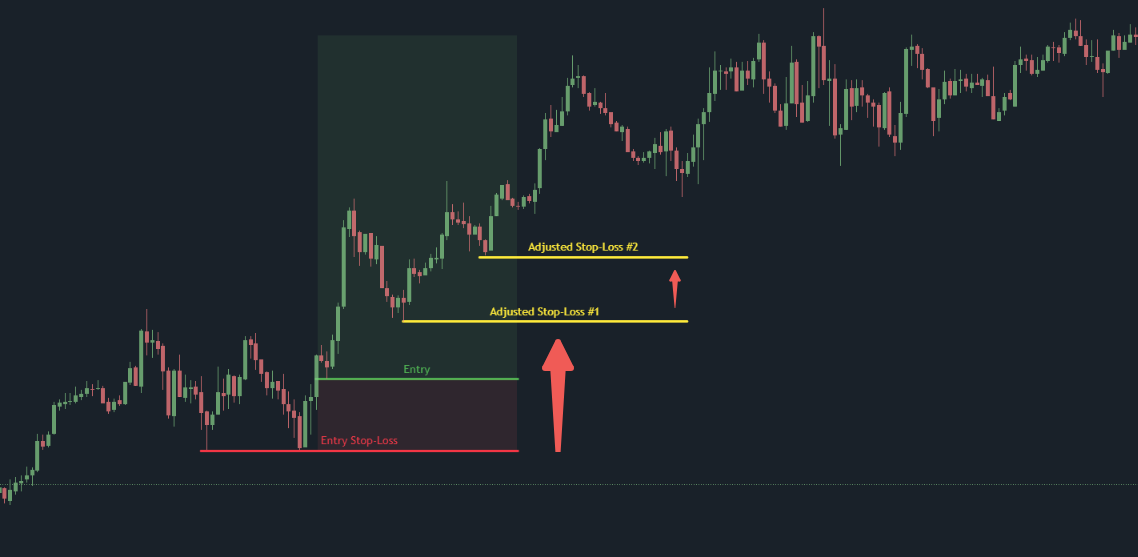
Stop-loss levels can be adjusted as the market moves in favor of the trade. This technique, known as a trailing stop-loss, allows profits to be protected while giving the trade room to continue moving in a favorable direction.
2. The Golden Rule of Risk Management
The initial stop-loss should never be increased beyond the planned risk level.
For example:
If the intended risk is $300 per trade, extending the stop-loss beyond the original point increases exposure and negates risk management.
The proper approach is to move the stop-loss closer to the entry point or progressively above it to secure profits, rather than expanding the risk.
3. Stop-Loss to Break-Even
When a trade moves into profit, the stop-loss can be moved to the entry price. This ensures that if the market reverses, the trade exits without a loss.
This method, called a breakeven stop-loss, allows capital preservation and is especially useful for maintaining risk-to-reward ratios in trades.
4. Trailing Your Stop-Loss to Lock in Profits
As the trade continues in a favorable direction, the stop-loss can be trailed to secure profits.
- Adjust the stop-loss according to market structure, such as recent highs or lows.
- Use these levels to protect gains if the market reverses.
- This ensures partial profits are captured rather than leaving gains unprotected.
Trailing stop-losses align risk management with ongoing price action, allowing profitable trades to continue safely.
5. Following Market Structure
Stop-loss adjustments should respect market structure:
- Markets rarely move in a straight line; consolidation periods are common.
- Identifying swing highs and lows helps avoid premature stop-outs.
- A break of structure often signals potential trend shifts and can indicate appropriate stop-loss placement. For example, below a recent swing low in an uptrend.
By following structure, stop-losses are positioned logically rather than arbitrarily.
6. Timeframe Considerations
Stop-loss placement should correspond to the timeframe of the trade:
- Avoid adjusting stop-losses based on smaller, choppier timeframes.
- For a 15-minute chart trade, rely on levels and structure visible within that timeframe.
- Using smaller timeframes may trigger premature stop-outs due to volatility.
Consistent timeframe alignment ensures stop-losses reflect the context of the trade.
Stop-loss management is essential for limiting losses and securing profits. A structured approach includes:
- Set the initial stop-loss below a swing low (for longs) or above a swing high (for shorts).
- Observe market structure to validate the trend.
- Trail the stop-loss along the market structure as the trade progresses.
- Repeat adjustments until the trade reaches its target or the market reverses.
This methodology ensures that even in the event of a reversal, trades exit with controlled risk and potential positive outcomes.