
1. Introduction
In financial markets, nearly every trade involves uncertainty. While price movements can create opportunity, they also introduce risk. Determining whether a trade is worth taking requires more than intuition or experience, objective and repeatable metrics are essential.
One of the most widely used and intuitive tools for this purpose is the Risk-to-Reward Ratio (RRR). This metric compares a trade’s potential reward to its potential loss, offering a clear, structured way to evaluate risk-adjusted trade quality.
Beyond entry selection, the RRR plays a critical role in capital preservation, consistency, and long-term performance. Mastery of this concept strengthens overall strategy robustness and supports sustainable trading results.
2. How to Calculate the Risk-to-Reward Ratio
The Risk-to-Reward Ratio is calculated by comparing the distance between the entry and take-profit levels to the distance between the entry and stop-loss levels.
For example:
- Entry Price: $3,100.
- Stop-Loss: $3,050.
- Take-Profit: $3,250.
Therefore,
- Risk= 50 points.
- Reward = 150 points.
This results in a 1:3 Risk-to-Reward ratio, meaning the potential reward is three times greater than the potential loss.
If the position size is one lot:
- A winning trade yields a profit of $150.
- A losing trade results in a loss of $50.
A 1:3 ratio allows multiple losses to be offset by a single winning trade. Even with a win rate of 25%, the account can remain break-even under consistent execution.
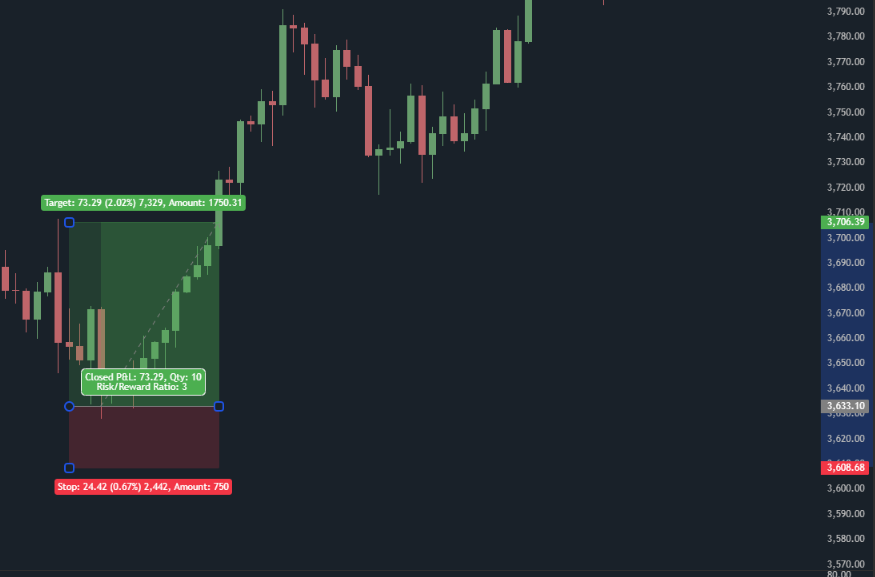
The same calculation applies to short positions, where risk is defined by the stop-loss distance above entry and reward by the target distance below entry.
Many charting platforms, such as TradingView, provide built-in tools to visually display stop-loss, take-profit, and RRR levels, streamlining this process.
3. Why does a Risk-to-Reward ratio matter?
The primary importance of the Risk-to-Reward Ratio lies in account management and capital protection.
Consider a sequence of four trades using a 1:3 ratio:
- Three trades result in losses.
- One trade reaches its target.
Despite a 25% win rate, the account breaks even. This highlights two key principles:
- A strong RRR allows profitable trades to offset multiple losses.
- High win rates are not a requirement for account stability or growth.
However, numerical ratios alone are insufficient. Targets must be realistically achievable. If a take-profit level requires price to break through major support or resistance, the probability of success decreases significantly.
Effective use of RRR requires alignment with market structure. Trades should present a clear and logical path to the target, combining mathematical advantage with technical feasibility.
4. Common pitfalls made by traders when using a Risk-to-Reward ratio
While RRR is a powerful tool, misuse can reduce its effectiveness. Two common issues frequently arise.
Overextended Profit Targets
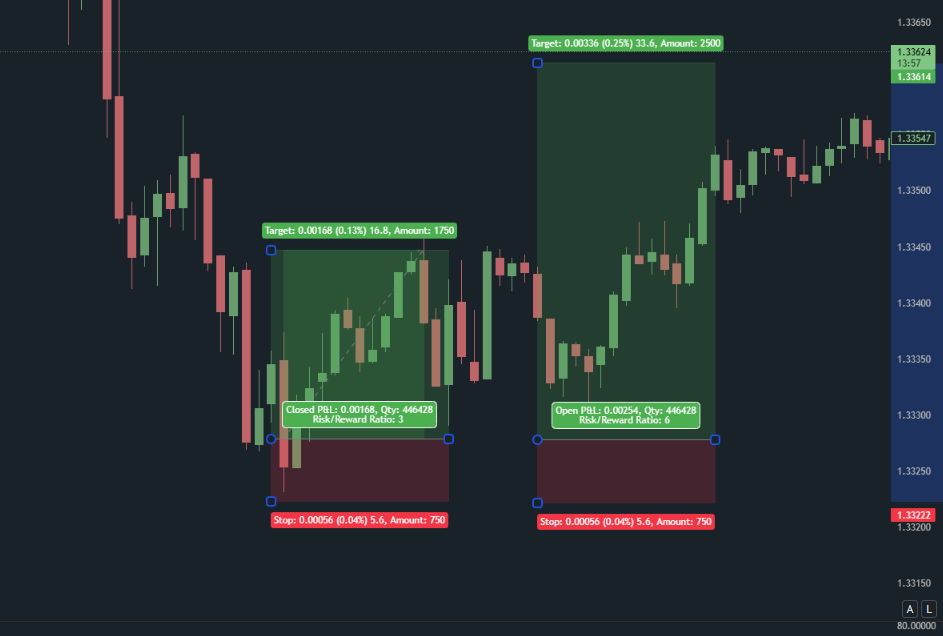
Placing the take-profit excessively far from entry increases the ratio numerically but lowers the probability of price reaching the target.
A 1:6 setup may appear attractive, yet often results in fewer successful trades due to unrealistic expectations.
Overly Tight Stop-Loss Placement
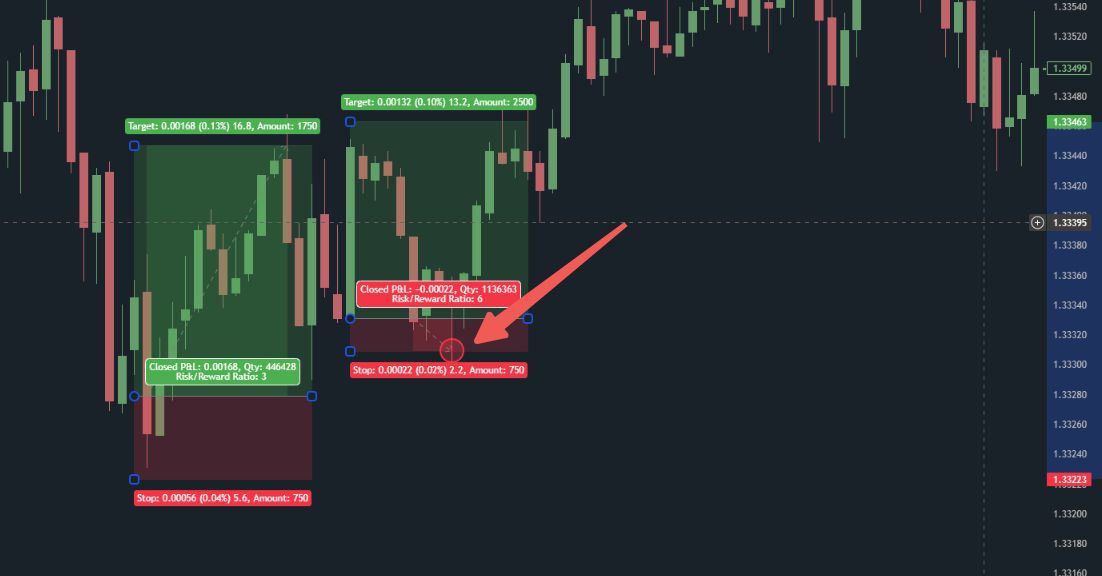
Reducing stop-loss distance improves the ratio mathematically but makes trades vulnerable to normal market fluctuations.
Tight stop-losses are frequently triggered before valid price movements develop, leading to avoidable losses even when the trade idea is correct.
The key lesson is that larger ratios are not inherently better. Stop-loss and take-profit placement must balance probability, structure, and trade longevity.
5. What Is the “Best” Ratio?
There is no universally optimal RRR. The appropriate ratio depends on strategy type, market conditions, and psychological tolerance.
- Higher Ratios: Capable of producing large gains but typically involve lower win rates and require patience. These strategies demand discipline to avoid premature exits.
- Moderate Ratios: Offer higher win rates and more consistent feedback. These ratios are often better suited for developing discipline and confidence, particularly during early stages of trading.
A gradual progression from moderate to higher ratios is generally a more sustainable path for long-term development.
The RRR is a foundational component of professional trading. It provides structure to decision-making, enhances capital protection, and allows traders to remain profitable even with modest win rates.
When combined with sound technical analysis and realistic target selection, the RRR becomes a powerful framework for evaluating trade quality and sustaining long-term performance.