
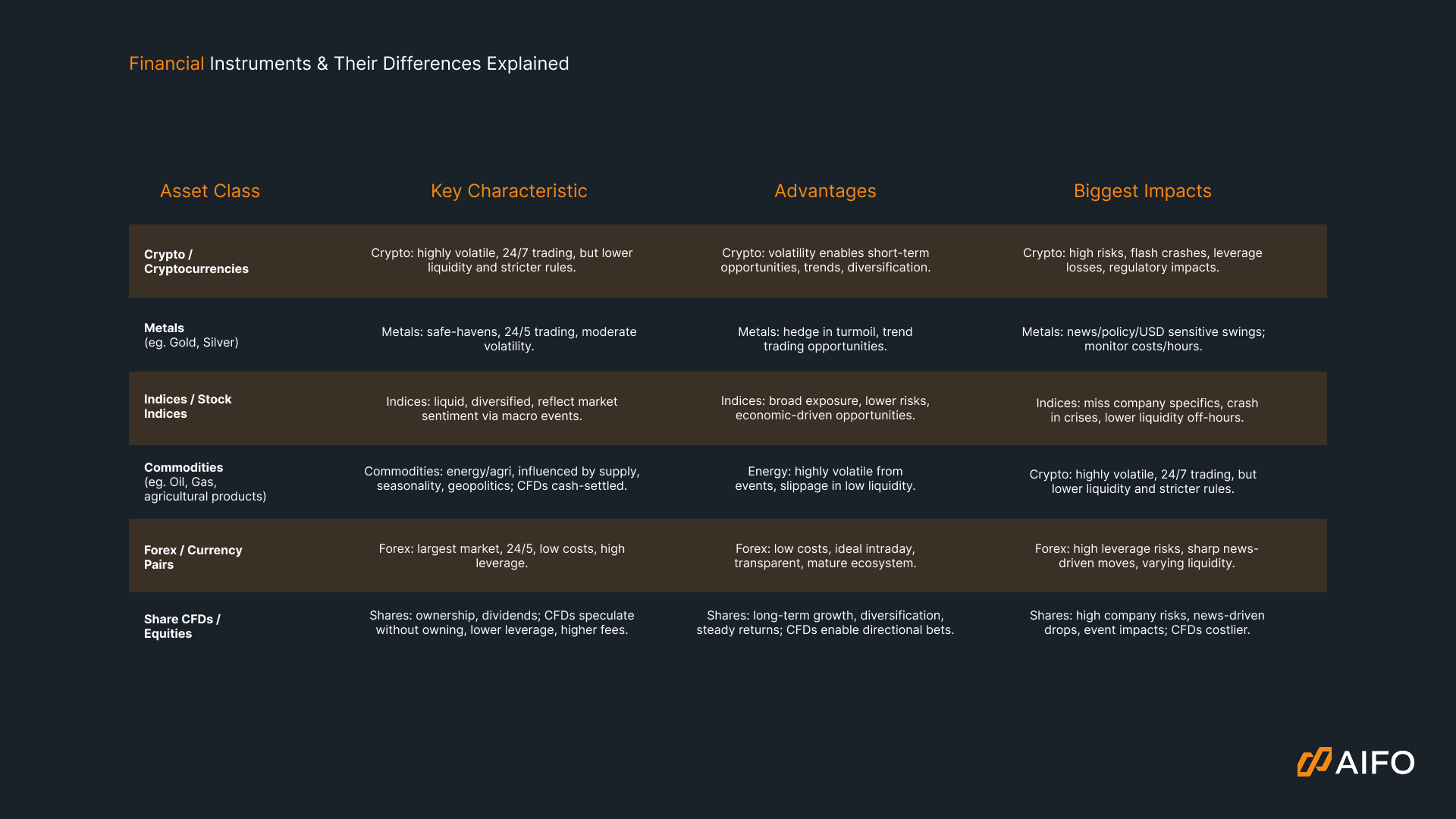
1. Stocks — Familiar and Beginner-Friendly
Stocks are among the oldest and most widely traded financial instruments. Purchasing a stock represents ownership in a publicly listed company.
Advantages
- High liquidity in major companies such as Microsoft, Meta, and Nvidia.
- Moderate volatility compared to faster-moving markets.
- Low barrier to entry, allowing participation with relatively small capital.
Disadvantages
- Limited trading hours based on exchange schedules.
- Regulatory restrictions such as the US Pattern Day Trader rule, which requires a minimum account balance for frequent day trading.
Stocks are well suited for beginners and long-term participants seeking a balance between stability and growth.
2. ETFs — Instant Diversification
ETFs represent a collection of assets grouped into a single instrument. These may include equities, bonds, commodities, or sector-specific exposures.
Advantages
- Built-in diversification reduces single-asset risk.
- Low fees and simplified management.
- Easy to trade, similar to individual stocks.
Disadvantages
- Trading hours are restricted to stock market sessions.
- Leveraged ETFs introduce complexity and higher risk, making them unsuitable for beginners.
ETFs are appropriate for traders seeking broad market exposure without selecting individual assets.
3. Bonds — Stable and predictable
Bonds are debt instruments issued by governments or corporations. Investors receive interest payments and principal repayment at maturity.
Advantages
- High stability, particularly government-issued bonds.
- Predictable income streams.
Disadvantages
- Lower returns compared to equities, forex, or cryptocurrencies.
- Reduced accessibility for newer market participants.
Bonds are commonly used by conservative traders or as a stabilising component within diversified portfolios.
4. Forex — The Global Currency Market
The forex market involves trading currency pairs such as EUR/USD or USD/JPY.
Advantages
- Operates 24 hours per day, five days per week.
- Extremely high liquidity, with daily volume exceeding $6 trillion.
- Low capital requirements for market entry.
Disadvantages
- Widespread use of leverage significantly increases risk
- Macroeconomic influences can be complex, although technical analysis alone is often sufficient.
Forex trading is well-suited for day traders and scalpers seeking continuous market access and rapid price movement.
5. Futures — Professional-Level Flexibility
Futures contracts are agreements to buy or sell assets such as indices, commodities, or currencies at a predetermined price on a future date. Most traders do not hold contracts to expiration but trade them for price movement.
Advantages
- High liquidity in major contracts (eg. S&P 500, NASDAQ, Gold, Crude Oil).
- Low capital requirements due to margin trading.
- Centralised pricing and transparency.
Disadvantages
- High leverage amplifies risk.
- Rapid price movements, particularly during news releases and session opens.
Futures markets are ideal for disciplined traders seeking structure, efficiency, and consistent volatility.
6. Cryptocurrencies — High Risk, High Reward
Cryptocurrencies are decentralised digital assets traded globally without fixed trading hours.
Advantages
- Market access 24/7.
- Significant price volatility offering large profit potential.
- Low capital requirements for participation.
Disadvantages
- Extreme volatility increases the likelihood of substantial losses.
- Elevated overall market risk.
Cryptocurrency trading is most suitable for traders who fully understand and accept elevated risk levels.
7. Commodities — Trading Real-World Assets
Commodities include physical assets such as gold, oil, natural gas, agricultural products, and industrial materials.
Advantages
- Strong volatility creates frequent trading opportunities.
- Gold often functions as a hedge against inflation.
- Diversification benefits relative to equity markets.
Disadvantages
- Prices are heavily influenced by geopolitical events, weather, and global supply factors.
- Market analysis can be challenging for beginners.
Commodity trading appeals to traders seeking diversification and exposure to real-world economic forces.