
The Elliott five-wave pattern describes how market prices tend to move in a natural, wave-like sequence, which is categorized into five distinct waves.
Wave 1: Initial Impulse
Wave 1 takes the lowest point after a sharp move in either direction, the price then advances to form the next highest high, or lowest low. This wave establishes the initial shift in momentum.
Wave 2: First Retracement
After Wave 1 completes, the market typically experiences a retracement of approximately 50% of Wave 1.
When a Fibonacci retracement is applied from the start of Wave 1 to the end of Wave 1, the price commonly pulls back toward the 0.6 retracement area, forming Wave 2.
Wave 3: Strongest Impulse Wave
Wave 3 begins from the low of Wave 2 and is characterized by a strong price movement that surpasses the high of Wave 1.
This wave:
- Forms a new higher high
- Is typically the longest and most powerful wave in the sequence
- Reflects broad market participation and increasing momentum
Wave 3 should never be the shortest impulse wave in a valid Elliott Wave structure.
Wave 4: Corrective Pullback
Following the completion of Wave 3, the market enters another corrective phase known as Wave 4.
Key characteristics:
- Wave 4 is a pullback against the direction of the trend
- The low of Wave 4 should remain above the high of Wave 1 in a valid uptrend
- This wave often shows consolidation rather than sharp retracement
Wave 5: Final Impulse
Wave 5 represents the final impulse in the five-wave sequence.
During this phase:
- Price advances to form a new higher high, breaking the high of Wave 3
- Momentum may appear weaker than Wave 3 despite higher prices
- Divergences with momentum indicators are common
Wave 5 completes the impulsive phase of the Elliott Wave cycle.
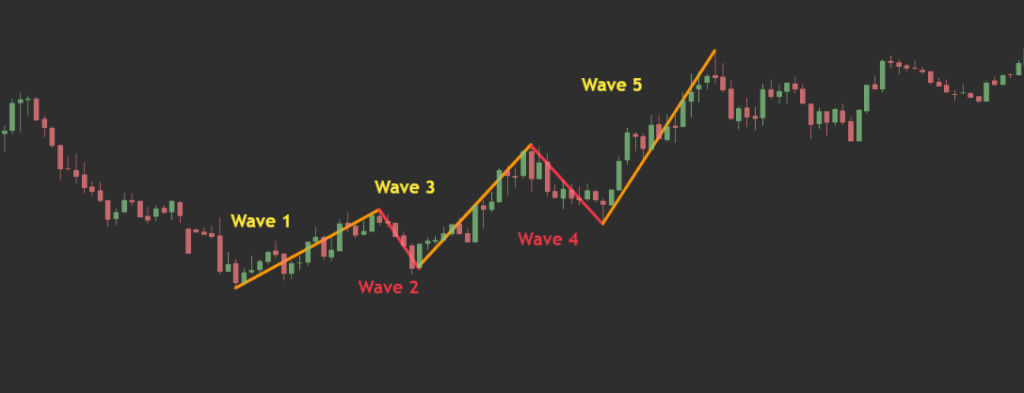
Each corrective pullback within the Elliott Wave structure—particularly Waves 2 and 4—can present potential entry opportunities in the direction of the prevailing trend.
These pullbacks allow traders to position in alignment with the dominant market structure while targeting higher highs (or lower lows in a downtrend).