
1. Define the Trading Objective
The first step in strategy development is defining clear objectives. This involves answering two essential questions:
- What is the desired trading goal?
- How much time and capital can be consistently committed?
The answers help determine whether the strategy should be designed for long-term trading, day trading, or scalping. Each style requires different tools, timeframes, and execution rules.
After defining the objective, the next step is selecting a market. Common choices include:
- Forex
- Equities
- Cryptocurrencies
- Futures
- Commodities
Market selection should align with available time, volatility preferences, and capital constraints.
2. Tailor the Strategy Framework
Once the objective and market are defined, a base strategy should be selected. This strategy can be created from scratch or adapted from an existing, well-documented methodology.
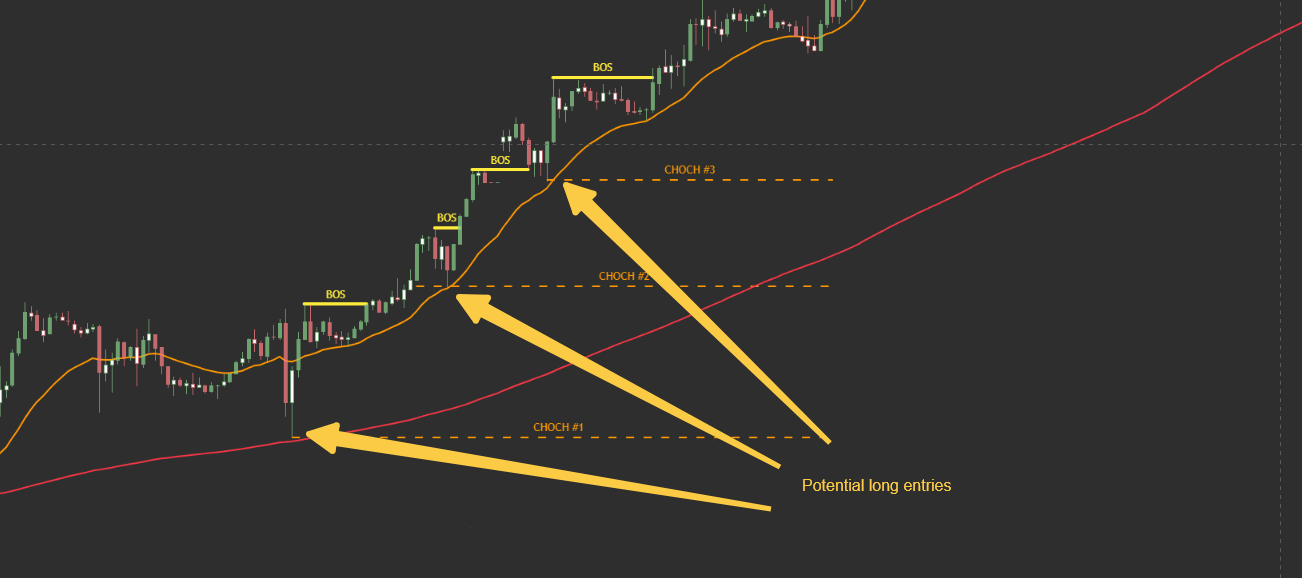
For example, a BOS / CHOCH framework can be combined with EMAs for confirmation:
- After a structural breakout, price may retrace toward the 21-period EMA, identifying potential entry zones.
- The 200-period EMA can be used as a higher-timeframe trend filter.
- Increasing separation between the 21 EMA and the 200 EMA often supports trend continuation bias.
Many strategies can be enhanced by adding confirmation tools such as indicators, market structure rules, or volatility filters. Over time, indicators can be adjusted or replaced to improve consistency and performance metrics.
3. Test the Strategy
A strategy should never be deployed in live markets without thorough testing.
Backtesting allows:
- Identification of weaknesses
- Refinement of entry and exit rules
- Risk control validation
- Performance evaluation across market conditions
Testing should be conducted in a controlled environment before capital is placed at risk. Altering strategies while trading live accounts often leads to inconsistent execution and unnecessary losses.
4. Develop Emotional Discipline
Many strategies fail not due to poor logic, but due to emotional misalignment.
Trading discipline requires:
- Strict adherence to predefined rules
- Execution only when valid confirmations are present
- Avoidance of overtrading during emotionally charged periods
Emotional control and rule-based execution are skills that must be developed alongside technical proficiency.