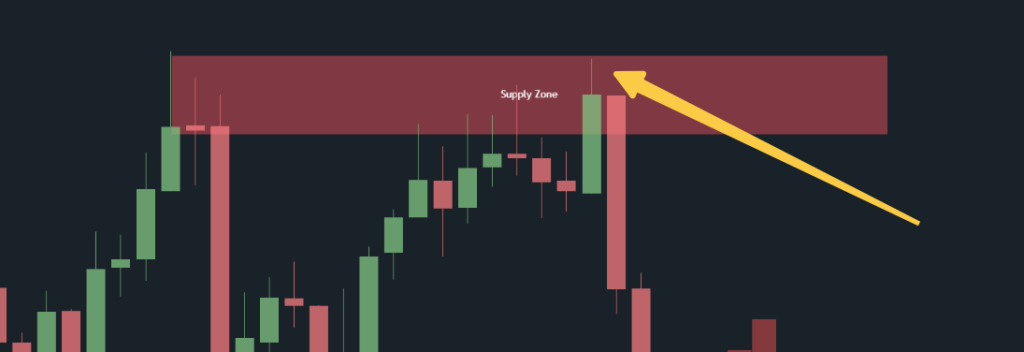
1. What is Supply and Demand Trading?
Supply and Demand Trading is a price action–based analytical approach that emphasizes the economic principles of supply and demand within financial markets. While similar to support and resistance concepts, this method places greater focus on the underlying market mechanics that drive price movement.
In financial markets, price fluctuations are fundamentally the result of an imbalance between supply and demand, in the same way that product prices in the real economy are shaped by the interaction of buyers and sellers.
This strategy aims to identify key price zones where supply or demand is particularly strong. These zones often serve as turning points where institutional participants enter or exit large positions, creating significant price reactions. Traders who apply this methodology typically seek to enter positions from these zones, taking advantage of the expected reversal or continuation that follows.
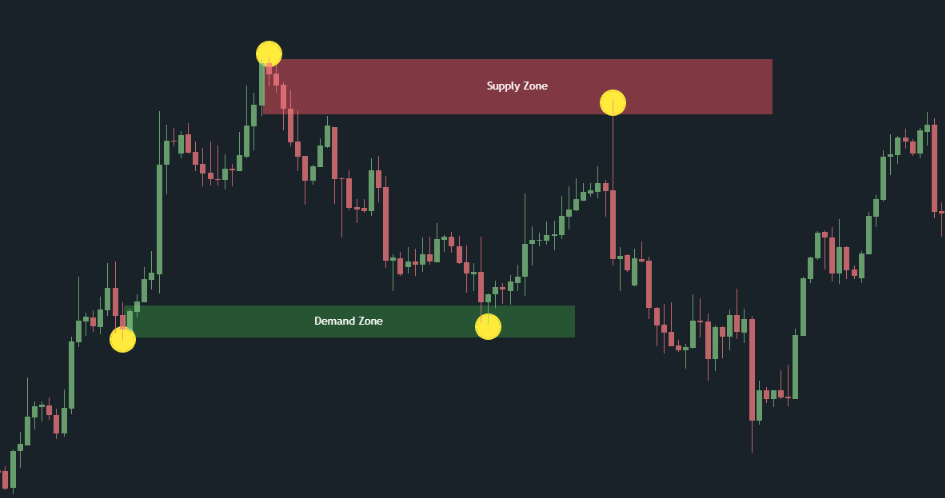
Example:
Supply and demand zones commonly form near major swing highs and lows, where market participants have previously shown strong buying or selling interest. Once such a zone is identified, market participants often wait for price to retrace into these areas before considering entry opportunities.
A protective stop-loss is generally placed beyond the supply or demand zone, while the take-profit target is set toward the next corresponding zone in the opposite direction.
2. Accurately Identifying Supply and Demand Zones
A frequent mistake among less experienced traders is the tendency to mark every swing high or swing low as a supply or demand zone. In practice, however, not all such points carry meaningful institutional order flow or market significance.
To ensure that a supply or demand zone is valid, two key criteria should be assessed:
- Break of Market Structure: A legitimate supply or demand zone often forms when price action breaks a previous market structure, confirming that strong buying or selling activity originated from that region.
- Rejection upon Re-Entry: When the price later revisits the zone, a clear rejection should occur. This is typically visible through long-wicked candles or strong reversal patterns such as engulfing formations, particularly noticeable on lower timeframes.
These conditions help confirm the presence of genuine institutional interest, strengthening the reliability of the zone for future trading decisions.